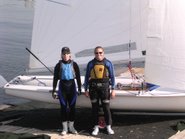
Okay… Newport Review Part II. Lolita proved too much a distraction for me … demented, disgusting and ridiculously well-written. It’s a trap, don’t fall into it. So Casey revved up the iPod and on came Counting Crows’ Omaha. Suitable to our destination today!
Let me describe for you the “triangle of death” we employed in that first week of sailing in Newport. We have two inflatable marks, but no tackle. So we used the government marks and plethora of moorings and lobster pot buoys that seemed to suit the wind direction and geography available to us off Newport harbor. Generally we located ourselves between Goat and Rose Island, where the breeze tended to channel through south to north. But one day we found our spot north of the bridge, right off the Naval War College. There a red nun, its green can counterpart across the channel, and a mid-channel green and red can formed an intimidating triangle course. The beat (from red/green can to red nun) was short – maybe three tacks in quick succession could be completed with the outgoing tide. The nun to can reach was very tight, as was the return reach to the bottom mark once we managed to pull out of the gybe (intact). It was very windy that day we discovered this race course. It took us three or four unsuccessful laps and a tantrum of frustration by yours truly before we succeeded in rounding the reach mark. We continued to go round and round, until our flailing survival began to smooth out. In that practice session we drew the attention of several Navy 44s out practicing, much of the Newport Bridge traffic (including Ezra Smith and Tim Healy who commented later to us that they saw us that day), and a Fountain speed boat full of beer swilling tough guys who had to stop and watch us in total awe of our stealthy speed!
Most of our solo practice sessions in Newport consisted of the following regimen. First we would sail out of the harbor under spinnaker which would usually result in a long tight reach across to the Jamestown side. We would douse the kite and head on a long upwind sail out to the ocean. We would concentrate on straight line speed and form. Every day we seem to develop a more sensitive feel for the balance and trim of the boat. As our boat handling improved we would stretch our time in the waves off Beavertail and between Point Judith and Brenton Reef (without a support boat we rarely extended this beyond an hour). Then we would set the chute and gybe our way back into the Bay. In between gybes we worked the boat through the waves and learned how important and effective pumping and weight movement can be. Once we were back in the Bay, we would find our boat handling marks and start working on sets, gybes, drops, and tacks until exhaustion.
Before she left for the Pan Am Games in Rio, Tracy often talked with us about our practice sessions and gave us advice on things to try, working from her memory in the class. Both Zack and John worked on our upwind and downwind techniques during the respective sessions they had with us. Zack introduced us to a great drill called “up-downs.” This involved us heading up from a run to a reach, and then back down to a run, and then back up to a reach over and over again. John taught us about speed and kinetic technique in the waves while running and broad reaching. Our culminating boat handling lessons came from Skip Whyte, the legendary 470 gybe expert. He worked with us on our gybing technique in light to medium air. He taught us to Rock & Roll with the all-important Boogie. All of these boat handling lessons from the few times we had coaching in Newport, combined with our individual drill time, have brought Casey and I a long way in our goal to become 470 boat handling masters. But we are not masters yet. That’s why we are going to San Francisco for some windy Bay action for a week before we spend many hours in the waters off Long Beach in September. We also are determined to have a coach with us for as much of that time as possible. We have already lined up a coach boat for San Francisco (and possibly Long Beach too) … and in that boat we will have Jonas Haggbom from Sweden, 470 coach extraordinaire!
Wednesday, August 8, 2007

Pictoral Newport
Now that Nicole is behind the wheel and Lolita by Vladimir Nabokov as read by Jeremy Irons is playing, it is my turn to continue to report what we have learned so far. After yesterday’s post about Pennsylvania, however, I have learned that I will feel a bit car sick after typing and my inability to spell and use grammar is evident. So I’ll catch up with some photos.
Sail Newport
Personal Inspiration: goats and llama (who is a snob)


While Sailing (Courtesy of Skip)


Sail Newport

Personal Inspiration: goats and llama (who is a snob)


While Sailing (Courtesy of Skip)


Newport in Review -- Part I
We are driving around Chicago this morning. Construction detours make things confusing. We stayed with Clayton Root last night. He is a lake region native, grew up on scows and raced solings for a while. His most recent sailing pursuits are on a friend’s Farr 40. He is a Cornell alum and a real estate developer. Casey and I chatted with him last night about his Cornell sailing days before turning in for the night. It was a long drive yesterday; we hit 6 states over the 16 hour drive. All is well with the rig.
This morning we had breakfast at the Golden Apple diner near Clayton’s. Oh, we just found our way to I-55 again, so we are back on track. We go to Omaha today. Should be a much shorter day on the road. We are looking forward to the visit with the Hendrickson’s and Keith’s smoked BBQ ribs!
As Casey has the first shift driving today, it is time for me to reflect on our training experience in Newport. Since we began our blog only recently, we need to play catch up.
Our initial goal for Newport was to achieve mastery of the 470 in all conditions with regard to boat handling. We wanted to be able to pull off any maneuver in any wind strength and any sea state, and have general control of the boat at all times. In Niantic we had a couple of windy days, but relatively flat water. The first week we were sailing in Newport it happened to be pretty windy (15-22 knots). With the tall ships and regular seasonal boat traffic (ferries, yachts, cargo ships) we were intimidated. It was pretty clear to us that our boat handling had not progressed far enough for us to start taking big risks. So during this first week we stayed in the Bay and concentrated on tight boat handling drills in the higher breeze range. We were encouraged by Tracy Nan Smith, one of the greatest hardcore dinghy sailors in my network of friends, that pushing ourselves on the “triangle of death” would lead to great progress. It was a challenging time on the water.
We were working out tacking and gybing techniques using mainly guesswork, influenced a little bit by my memory. There don’t seem to be any available “from the experts” articles on 470 boat handling. Getting some coaching on the water seemed increasingly important. We didn’t want to learn the wrong ways of doing things, only to start all over again once we realized the error of our ways. We had a major stumbling block in our plans for guest coaches – no coach boat. You would not believe the number of hard bottom inflatables in Newport. They are everywhere. And they are being used all the time. Working out a charter seemed either way too expensive or way too inconvenient for the owners. I suppose we could have pushed a little harder, or hunted a little more creatively, but we were faced with time management issues. A huge reality of the US Olympic sailing campaign is that all of the management tasks parallel the athlete’s physical and skill training. During the day the athlete needs to do specific physical exercise to gain strength and endurance, practice on the water with a constructive plan for attaining goals and objectives, maintain the boat for functionality and safety, eat for health and energy, drink water, manage the sun, and get plenty of sleep. But the “campaign” also requires the athlete to fit in logistical work time as well: finances, networking, research… it is in this latter realm that finding a coach boat and scheduling guest coaches falls. The answer ended up being very simple, but when you are exhausted at the end of the day, the ideas and follow up don’t roll out of your head so easily. It wasn’t until the last 2 weeks of our Newport training that we managed to put something together. The Comfort family turned out to be a major ally to us. If we only had thought of this contact sooner! They loaned us their RIB so that Zack Leonard could come out on the water with us one Friday afternoon. Jeff Johnstone also loaned us his J Boats RIB so that Skip Whyte could coach us on two separate occasions. We also had a day on the water with Kiwi coach John Morgan, who borrowed a boat from Connanicut YC. These days with coaches on the water proved very valuable. Not only did the coaching lead to fruitful practice sessions packed full of learning for us, but each session ended up being a great confidence boost for us. Ironically, the few days we had with coaches confirmed that our solo work had been very productive, despite some of the frustration of navigating in-the-dark the intricacies of the 470. What this tells me is that the bottom line for us has been to spend as much time in the boat as possible. Casey and I are smart and driven people. No matter what we are doing in the boat, the time is productive. Our solo work has provided a platform for coaches to take off from when they work with us. We are more than a lump of clay. They see our potential.
My turn to drive. I’ll be back! -nb
This morning we had breakfast at the Golden Apple diner near Clayton’s. Oh, we just found our way to I-55 again, so we are back on track. We go to Omaha today. Should be a much shorter day on the road. We are looking forward to the visit with the Hendrickson’s and Keith’s smoked BBQ ribs!
As Casey has the first shift driving today, it is time for me to reflect on our training experience in Newport. Since we began our blog only recently, we need to play catch up.
Our initial goal for Newport was to achieve mastery of the 470 in all conditions with regard to boat handling. We wanted to be able to pull off any maneuver in any wind strength and any sea state, and have general control of the boat at all times. In Niantic we had a couple of windy days, but relatively flat water. The first week we were sailing in Newport it happened to be pretty windy (15-22 knots). With the tall ships and regular seasonal boat traffic (ferries, yachts, cargo ships) we were intimidated. It was pretty clear to us that our boat handling had not progressed far enough for us to start taking big risks. So during this first week we stayed in the Bay and concentrated on tight boat handling drills in the higher breeze range. We were encouraged by Tracy Nan Smith, one of the greatest hardcore dinghy sailors in my network of friends, that pushing ourselves on the “triangle of death” would lead to great progress. It was a challenging time on the water.
We were working out tacking and gybing techniques using mainly guesswork, influenced a little bit by my memory. There don’t seem to be any available “from the experts” articles on 470 boat handling. Getting some coaching on the water seemed increasingly important. We didn’t want to learn the wrong ways of doing things, only to start all over again once we realized the error of our ways. We had a major stumbling block in our plans for guest coaches – no coach boat. You would not believe the number of hard bottom inflatables in Newport. They are everywhere. And they are being used all the time. Working out a charter seemed either way too expensive or way too inconvenient for the owners. I suppose we could have pushed a little harder, or hunted a little more creatively, but we were faced with time management issues. A huge reality of the US Olympic sailing campaign is that all of the management tasks parallel the athlete’s physical and skill training. During the day the athlete needs to do specific physical exercise to gain strength and endurance, practice on the water with a constructive plan for attaining goals and objectives, maintain the boat for functionality and safety, eat for health and energy, drink water, manage the sun, and get plenty of sleep. But the “campaign” also requires the athlete to fit in logistical work time as well: finances, networking, research… it is in this latter realm that finding a coach boat and scheduling guest coaches falls. The answer ended up being very simple, but when you are exhausted at the end of the day, the ideas and follow up don’t roll out of your head so easily. It wasn’t until the last 2 weeks of our Newport training that we managed to put something together. The Comfort family turned out to be a major ally to us. If we only had thought of this contact sooner! They loaned us their RIB so that Zack Leonard could come out on the water with us one Friday afternoon. Jeff Johnstone also loaned us his J Boats RIB so that Skip Whyte could coach us on two separate occasions. We also had a day on the water with Kiwi coach John Morgan, who borrowed a boat from Connanicut YC. These days with coaches on the water proved very valuable. Not only did the coaching lead to fruitful practice sessions packed full of learning for us, but each session ended up being a great confidence boost for us. Ironically, the few days we had with coaches confirmed that our solo work had been very productive, despite some of the frustration of navigating in-the-dark the intricacies of the 470. What this tells me is that the bottom line for us has been to spend as much time in the boat as possible. Casey and I are smart and driven people. No matter what we are doing in the boat, the time is productive. Our solo work has provided a platform for coaches to take off from when they work with us. We are more than a lump of clay. They see our potential.
My turn to drive. I’ll be back! -nb
Tuesday, August 7, 2007
Where were the Amish?

I entered
The eastern part of the state was surprisingly uneventful which did not appease my worry as I was certain that something was waiting for us down the road. Nicole mentioned that she thought we had entered the
But we planned to work out at a gym everyday while driving across the country, so we exited the highway in


Needless to say, the other residents of

Monday, August 6, 2007
Road Trip Hurdle #1
It’s Monday morning, August 6. We are heading to California this week. Last night we had planned to finish packing up in Newport and head to Old Lyme to see my parents before the long road trip. We raced BBR in a Vanguard 15 this weekend, so we were tying up 470 masts and hooking up the trailer pretty late in the evening. When we did the requisite lights check on the 470 trailer, we discovered problems. After an hour or so of fiddling and fretting, we aborted the mission for the night and headed back to the Freedom House to sleep and wait for daylight.
Casey just woke up. We feel better about tackling the trailer lights now, and safer driving if they remain compromised. After three days of hiking on a V15 and duking it out with college kids, we needed some rest to handle the Land Cruiser laden with one boat on top, one boat in tow, and four masts strapped to either side. (We’ll show you a picture later.)
We have lots to write, but it will have to wait because it’s time to hit the road.
Casey just woke up. We feel better about tackling the trailer lights now, and safer driving if they remain compromised. After three days of hiking on a V15 and duking it out with college kids, we needed some rest to handle the Land Cruiser laden with one boat on top, one boat in tow, and four masts strapped to either side. (We’ll show you a picture later.)
We have lots to write, but it will have to wait because it’s time to hit the road.
Wednesday, July 25, 2007
Niantic
During our first weeks of training in Niantic we were pretty conservative. We sailed alone in the afternoon hours. Most of our time on the water we experienced perfect flat water and light to moderate breezes. We concentrated on basic boat handling and simply getting to know the boat. We had great practices just sailing around the bay. Most of the time, we were quiet. We knew what we did right and wrong, and there was only a need for trying things over and over again. The goal in Niantic was to get to know the 470 and get familiar with sailing it in a range of wind speeds. One of our last days before moving to Newport happened on a Wednesday evening in a strong Northeasterly wind (gusts to 25). The Niantic Bay YC Wednesday night racing was going on, so we were happy to go test ourselves knowing there were a lot of other boats around in case something went wrong. We blasted all over the bay, out into Long Island Sound, flipped, righted, jumped into races and back out. We had a blast and put on a show! We truly thank NBYC for supporting our first stage of training.


Subscribe to:
Posts (Atom)